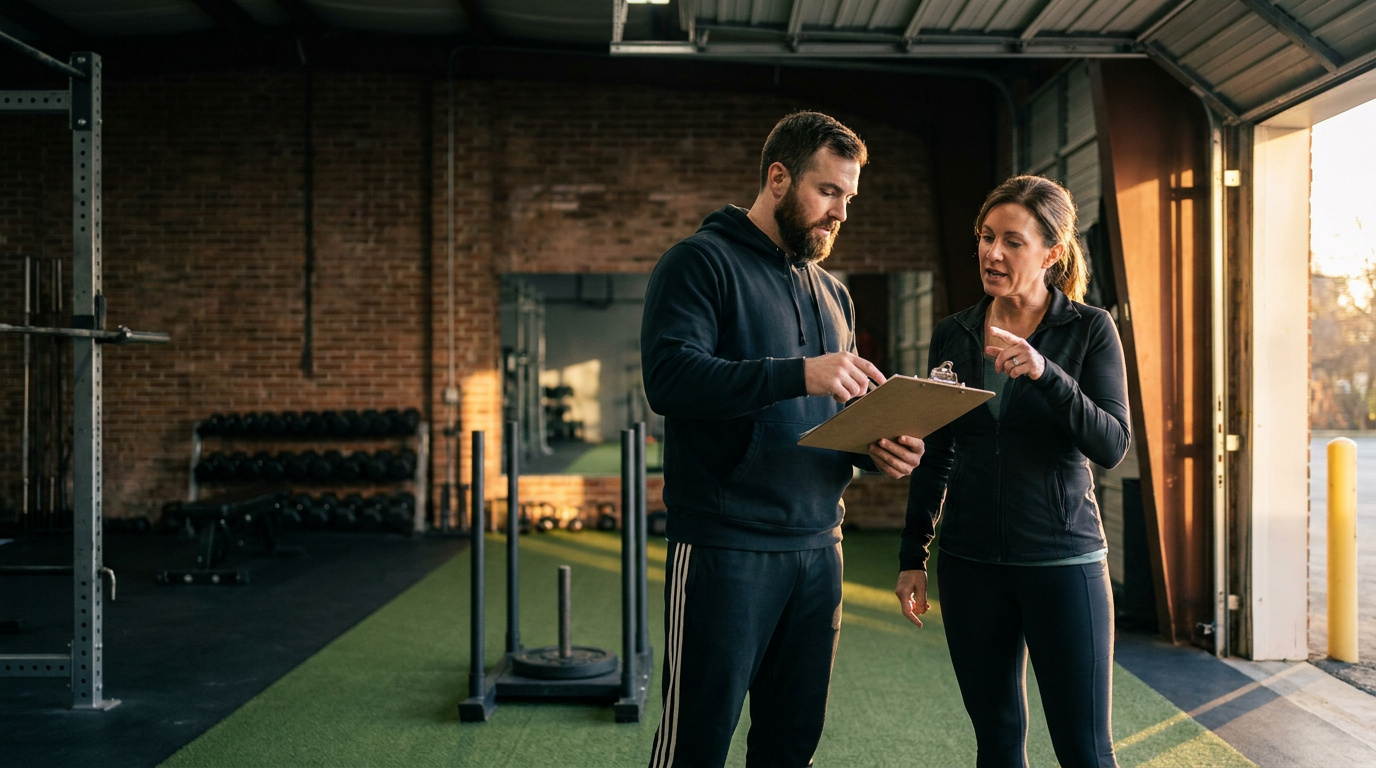

By September, most competitive athletes have received their first real feedback of the season. Maybe it came directly from a coach after tryouts. Maybe it showed up in a conditioning test, a depth-chart decision, or the first few practices. Maybe it was not said out loud at all—but the athlete felt it: getting pushed off the ball, losing speed late in drills, struggling to get off the ground, or finishing every practice feeling more beat up than they should.
That feedback can be frustrating. It can also be incredibly useful.
The athletes who improve most during the season are not the ones who take every comment personally or respond by doing random extra workouts. They are the ones who treat feedback as data. “Get stronger,” “move faster,” “improve your conditioning,” and “be more durable” are not insults or vague labels. They are clues. With the right assessment and plan, those clues can become a targeted strength and performance strategy for the rest of the fall.
At The Rack Athletic Performance Center, the goal is about more than simply making athletes tired. Our focus is on identifying what may be holding performance back, developing the physical qualities that matter most, and helping athletes arrive at practice, games, and competition stronger and better prepared. With guidance from an Expert Personal Trainer Vinings, athletes receive individualized programming based on a detailed needs analysis that considers their sport, current abilities, training and injury history, schedule, and specific goals. Rather than relying on a generic workout routine, every program is designed to address the athlete’s unique needs and support long-term performance.
Early-Season Feedback Is Information
Tryouts and the opening weeks of a season are a reality check. Athletes finally see how their preparation holds up against teammates, opponents, game speed, and a structured practice schedule.
By this point, most athletes have a better understanding of where they stand in several important areas:
- Playing time and role on the team.
- Coach comments about strength, speed, conditioning, or consistency.
- Results from fitness or conditioning tests.
- How they handle contact, repeated sprints, jumps, or long practices.
- How their body feels after games and training.
- Whether they can perform late in competition the same way they perform early.
This is valuable information because it is specific to the environment that matters most: the athlete’s actual sport.
A coach saying, “You need to get stronger,” may not be a complete training program—but it does point toward an important question: stronger in what way? Is the athlete struggling to hold position in contact? Do they lack lower-body force? Is their trunk stability breaking down? Are they losing their footing or failing to decelerate effectively?
The same process applies to any piece of feedback. Rather than reacting emotionally, start by getting curious.
Ask:
- What specifically happened that led to this feedback?
- When does the problem show up most often?
- Is it a strength issue, a power issue, a conditioning issue, a movement issue, or a recovery issue?
- What physical quality would make the biggest difference?
- How can that quality be trained without interfering with practices and games?
That is how early-season feedback becomes a plan instead of just a frustration.
Common Feedback Athletes Hear
Athletes often hear similar comments across sports, but the underlying reason can vary widely. A quality program does not just repeat the comment—it finds the physical gap behind it.
| Coach Feedback | What It May Mean | Training Priority |
| “You need to get stronger.” | Difficulty holding position, getting displaced in contact, weak lower body or trunk | Progressive lower-body, posterior-chain, and trunk strength |
| “You need more speed.” | Weak acceleration mechanics, poor force application, lack of power or sprint capacity | Sprint mechanics, force production, plyometrics, explosive strength |
| “You need better conditioning.” | Poor aerobic base, inefficient movement, low repeat-sprint ability, poor pacing | Individualized energy-system development and movement efficiency |
| “You need to jump higher.” | Lower-body power gap, poor landing mechanics, strength deficit | Strength foundation, jumping progression, landing and tendon capacity |
| “You look tired late in games.” | Accumulated fatigue, low capacity, poor recovery, lack of strength endurance | Load management, conditioning, recovery, strength maintenance |
| “You keep getting banged up.” | Weak links, poor tissue tolerance, rapid workload increase, incomplete recovery | Prehab, accessory work, movement control, load management |
The key is not to guess. An assessment helps determine which explanation is most likely for that individual athlete. Effective programs consider sport demands, current fitness, movement patterns, injury history, training experience, available time, and performance testing when determining what to train.
If Conditioning Is the Issue: Build Capacity With Purpose
“Get in better shape” may be the most common and least specific phrase in sports.
Many athletes respond by running extra miles, doing exhausting circuits, or adding conditioning after every practice. That response can make them feel productive, but it does not always solve the real problem. In fact, adding random fatigue on top of a packed in-season schedule can reduce movement quality, worsen recovery, and leave the athlete even flatter on game day.
Conditioning needs to match the athlete’s sport and current limitations.
A soccer player who cannot repeat high-speed efforts late in a match may need better aerobic capacity, more efficient movement, and carefully dosed repeated-sprint work. A basketball player whose legs disappear in the fourth quarter may need a combination of strength endurance, aerobic recovery capacity, and better workload management. A football athlete who struggles during longer drives may need a different plan than a cross-country athlete who lacks sustainable race pace.
Smart energy-system development considers three broad demands:
- Explosive output: Short, high-intensity efforts such as sprinting, jumping, hard cuts, tackles, and powerful plays.
- Repeated high-intensity work: The ability to perform hard efforts again and again with incomplete rest.
- Aerobic recovery: The capacity to recover between plays, shifts, points, repetitions, practices, and training days.
The athlete who lacks the aerobic capacity to recover between explosive efforts may look “out of shape,” even if they can sprint fast once. The athlete who has endurance but lacks strength may be able to run all day but still get pushed around or lose power late in competition.
A performance gym helps identify the missing quality and builds it without blindly piling on volume. Load-management research and consensus guidance emphasize monitoring training and competition demands, adjusting them as needed, and scheduling adequate recovery after intensive periods, travel, and competition.
That matters in season. The goal is not to win a conditioning workout on Tuesday and have dead legs on Friday. The goal is to become more capable while remaining available for the sport.
If Strength or Power Is the Issue: Build the Engine
A lot of athletes hear “get stronger” and immediately think they need to max out on a barbell. But strength development is not about chasing the heaviest number possible in a single session. It is about gradually building the physical capacity to produce force, absorb force, hold positions, and express power when the sport demands it.
For most athletes, a strong foundation starts with:
- Squat patterns.
- Hinge patterns.
- Single-leg strength.
- Posterior-chain development.
- Upper-body pushing and pulling.
- Trunk stability.
- Grip and contact strength when relevant.
- Controlled jumping, landing, and explosive work.
The posterior chain—the glutes, hamstrings, and muscles of the upper and lower back—is especially important for many athletes. It contributes to acceleration, sprinting, jumping, deceleration, posture, and force transfer. Athletes who have trouble exploding off the line, holding their ground, changing direction, or staying powerful late in competition often benefit from a stronger lower body and trunk.
The right progression depends on the athlete. A newer athlete may need to master bodyweight movements, split squats, hip hinges, and basic landing mechanics before loading a barbell. A more experienced athlete may need targeted strength work to improve a weak point in a squat, deadlift, pull, or Olympic-lifting derivative.
The principle stays the same: build the athlete, not just the weight-room number.
Strength training should make sport movement more effective. It should help athletes accelerate harder, jump higher, hold stronger positions, and maintain quality under fatigue. Programs should be based on the athlete’s health status, training age, capabilities, and goals, with exercise selection, volume, intensity, work-rest periods, and progression chosen to improve performance while minimizing unnecessary injury risk.
If Durability Is the Issue: Stop Ignoring the Warning Signs
Some athletes are talented, fast, and strong—but they are constantly dealing with something. Tight hamstrings. Achy knees. Shin pain. Shoulder irritation. Low-back stiffness. Recurrent ankle rolls. They may be told they need to “toughen up,” but recurring pain is not always a toughness problem.
Often, it is a capacity problem.
Durability is the ability to tolerate the specific physical demands of sport over time. It depends on strength, mobility, movement control, tissue capacity, recovery, and appropriate workload progression. When any one of those pieces is missing, the athlete may repeatedly feel beat up.
A durability-focused plan may include:
- Single-leg strength to improve hip, knee, and ankle control.
- Hamstring and calf work to build tissue capacity.
- Upper-back, scapular, and rotator-cuff work for throwing and overhead athletes.
- Controlled deceleration and landing drills.
- Core training focused on stability and force transfer.
- Mobility work where it genuinely improves useful movement.
- Adjustments to total training volume during heavy practice or game weeks.
The goal is not to turn every session into rehab. It is to make prehab part of performance training.
An athlete who has recurring knee pain might need stronger quads, glutes, hamstrings, calves, and better single-leg control—not just endless stretching. An athlete with shoulder irritation may need improved upper-back strength, scapular control, and a better plan for throwing or pressing volume. An athlete who rolls their ankles may need foot, ankle, calf, balance, and deceleration work in addition to sport-specific skill training.
Individual injury-prevention planning should include the athlete’s injury history, sport-specific risks, and active movement capabilities, rather than relying on a one-size-fits-all list of corrective exercises.
Why Team Practice Cannot Do Everything
Team practices are necessary. They teach the sport: systems, tactics, skills, communication, and decision-making under pressure.
But team practice is not usually designed to solve every athlete’s individual physical limitations.
A coach has an entire roster to manage. Practice must prepare the group for competition, not provide a personalized strength program for every player. The athlete who needs stronger hamstrings, better jump mechanics, more trunk stability, or a specific conditioning progression may not receive enough individualized attention within the normal team setting.
That is not a criticism of team coaches. It is simply a reason individualized performance training matters.
A good performance gym bridges the gap between what the team needs and what the individual athlete needs. It assesses the athlete, identifies the highest-value training priorities, and builds a plan around the athlete’s sport schedule.
For example:
- Team practice may include conditioning, but the athlete may need a specific aerobic base and repeat-sprint plan.
- Team lifting may include standard exercises, but the athlete may need extra posterior-chain work or single-leg strength.
- Team warm-ups may be broad, but the athlete may need ankle, hip, shoulder, or landing preparation.
- A coach may identify a weakness, but performance training turns that weakness into measurable progress.
This is why individualization matters. The most effective programs account for biological needs, biomechanics, sport movement demands, injury considerations, training experience, goals, and schedule constraints.
Case Study: Soccer Player Told to Get Stronger
Consider a high school soccer player who hears, “You have skill, but you get pushed off the ball too easily.”
The wrong response would be to randomly add heavy squats every day or spend hours doing upper-body workouts that do not address the real issue.
A better plan starts with an assessment:
- Can the athlete produce force through one leg?
- Do they have enough trunk stability to hold position during contact?
- Are the hips, glutes, hamstrings, and adductors strong enough to support cutting and contact?
- Are they recovering from practices, matches, and travel?
A targeted in-season plan might include:
- Two strength sessions per week.
- Split squats or rear-foot-elevated split squats.
- Romanian deadlifts or hip hinges.
- Hamstring curls and adductor work.
- Rows, carries, and trunk stability drills.
- Controlled acceleration and deceleration work when appropriate.
The athlete does not need to become a powerlifter. They need to become harder to move, stronger through contact, more stable on one leg, and better able to repeat those efforts throughout the match.
Case Study: Volleyball Player Told to Improve Jump and Landing
Now consider a volleyball player whose coach says, “You need more vertical and better control on landings.”
The answer is not simply more jumping. If the athlete keeps adding high-volume jumps without improving strength, tendon capacity, and landing control, the knees and ankles may become more irritated.
A smart plan may include:
- Squat and hinge patterns to build lower-body force.
- Split squats and step-ups for single-leg strength.
- Calf work for ankle stiffness and force transfer.
- Hamstring and glute work for jumping and landing support.
- Landing mechanics: quiet landings, snap-downs, stick positions, and controlled deceleration.
- Progressive jump training based on the athlete’s tolerance and game schedule.
The goal is to improve how much force the athlete can produce and how well they can absorb force. Better jumping without better landing control is incomplete preparation.
Case Study: Basketball Player Told to Improve Endurance
A basketball player may hear, “Your effort is great early, but you fade late.”
The athlete’s first instinct may be to run suicides every day. But if practices already include repeated sprinting, scrimmages, and conditioning, that approach may only add fatigue.
The assessment should look deeper:
- Is the athlete’s aerobic capacity limiting recovery between intense bursts?
- Do they have enough lower-body strength to maintain posture and movement late in games?
- Are they inefficient in sprint, shuffle, stop, and change-of-direction patterns?
- Is sleep, hydration, or nutrition creating a recovery problem?
- Are they trying to train too hard outside practice?
A more effective plan might use:
- Short, low-impact aerobic work on selected days.
- Carefully timed repeat-effort conditioning.
- Strength work that supports force production and resilience.
- Movement drills for deceleration and change of direction.
- Load adjustments around games and demanding practice days.
- Recovery targets for sleep, hydration, and fueling.
The athlete’s goal is not just to survive a conditioning test. It is to play with energy, skill, and decision-making ability when the game is on the line.
Turning Feedback Into a Plan
Athletes can use this simple process after tryouts, early practices, or their first few games.
Step 1: Write down the feedback
Be specific. Instead of “Coach said I need to be better,” write:
- “I was told I get pushed off the ball.”
- “I slowed down late in conditioning.”
- “My landing mechanics need work.”
- “I have recurring shin pain after practice.”
- “I need to be more explosive off the first step.”
Specific feedback produces specific action.
Step 2: Identify the performance problem
Ask what the feedback looks like in real competition. When does it happen? Is it early or late in the game? Is it during contact, jumping, sprinting, changing direction, or repeated effort?
Step 3: Get assessed
A proper assessment examines movement quality, strength, power, work capacity, injury history, training experience, sport demands, and schedule. This helps prevent athletes from choosing exercises based solely on what is popular online.
Step 4: Choose one or two priorities
Trying to fix everything at once usually leads to inconsistent training. Choose the highest-impact priorities first.
For example:
- Strength and trunk stability.
- Jumping and landing control.
- Aerobic recovery capacity.
- Posterior-chain strength.
- Shoulder durability.
- Single-leg strength and deceleration.
Step 5: Fit training around the season
In-season training should support performance, not compete with it. Volume, exercise choice, and intensity need to be adjusted around games, travel, practices, and fatigue.
Research and expert guidance on athlete load management consistently emphasize monitoring both training and competition demands, avoiding abrupt workload spikes, and providing sufficient recovery after intense work, travel, and competition.
Step 6: Reassess and adjust
A program is not finished once it is written. Track how the athlete feels, how they perform, and whether the original issue is improving. If the plan is working, progress it. If fatigue is building, adjust it before pain or burnout takes over.
The Difference Between Feedback and a Takeover
Early-season feedback can feel like a verdict: not fast enough, not strong enough, not conditioned enough, not durable enough.
It is not.
It is a starting point.
Athletes who respond with intention can make meaningful improvements during a season. They can become stronger through contact, more explosive off the ground, more confident in their movement, and more capable late in games. But that does not happen through random workouts, punishment conditioning, or simply hoping that practice alone will solve the issue.
It happens through targeted, individualized performance training.
The Rack Athletic Performance Center helps athletes turn vague feedback into a clear strength and performance plan. Through an assessment, athletes can identify what is actually limiting them, build a program around their sport schedule, and train with purpose through the rest of the fall.
Bring the feedback from tryouts, a coach’s conversation, a conditioning test, or the first few weeks of practice. Turn “get stronger” or “get faster” into a real plan—and give yourself the chance to take over when it matters most.