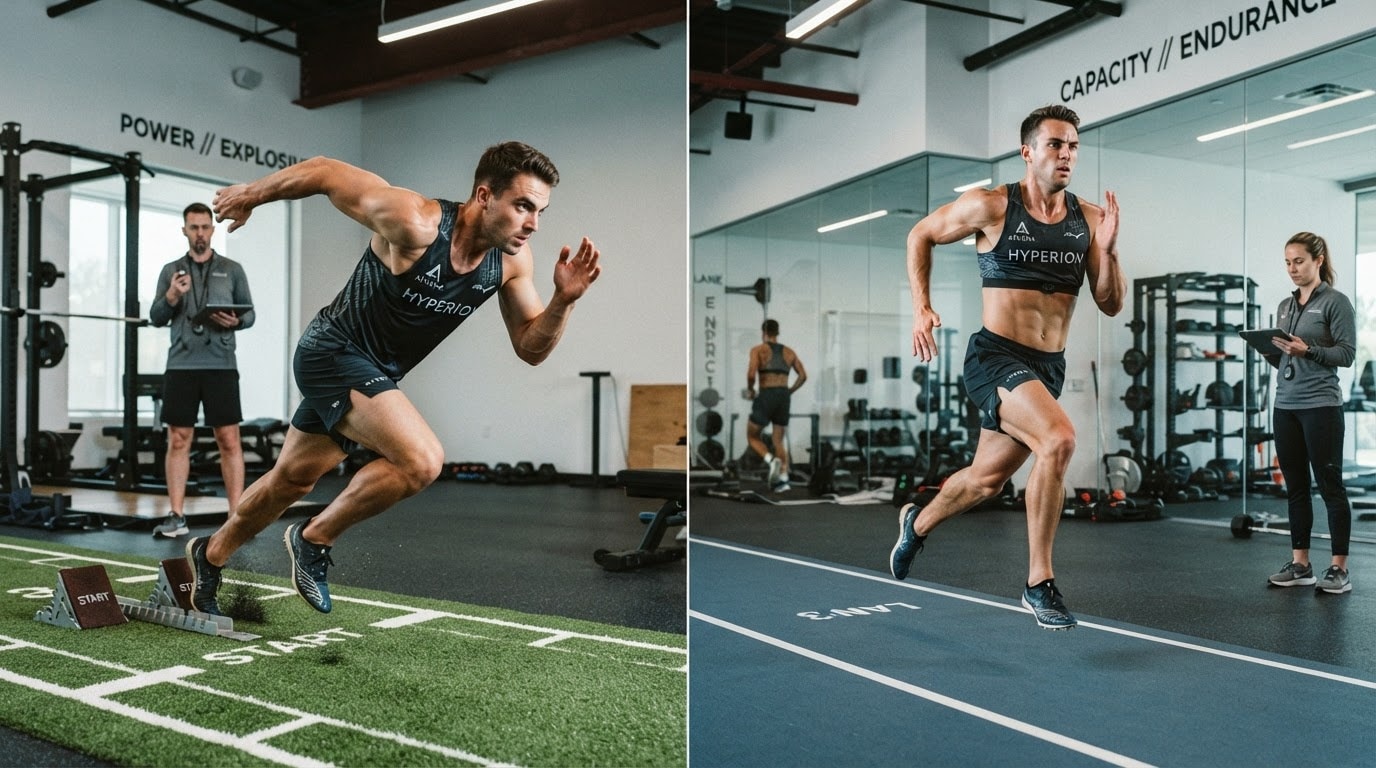
In the world of performance, there is a massive difference between “working out” and “training.” Working out is about chasing a sweat, feeling the burn, and leaving the gym exhausted. Training, however, is a calculated move toward a specific objective.
The bridge between those two worlds is assessment. If you aren’t testing, you are simply guessing with your time, your energy, and your results.
The Map vs. The Compass
Imagine trying to drive to a new destination without a GPS. You might know you need to head “North,” but without knowing your exact starting point, you’re likely to take several wrong turns.
In the gym, your goals are the destination. Testing—whether it’s a vertical jump, a 10-yard split, or force plate analysis—is your GPS. It tells us exactly where your power leaks are, where your imbalances lie, and exactly how much “fuel” we need to add to the tank to get you where you want to go.
1. Objectivity Over Emotion
We’ve all had days where we felt “slow” but ended up hitting a PR, or days where we felt “electric” but couldn’t move the bar. Our feelings are often liars.
Data doesn’t have “off days.” By using objective metrics, we can see if a program is actually working or if we’re just spinning our wheels. If your goal is explosive power and your jump height hasn’t moved in six weeks, the data tells us it’s time to pivot—long before you waste a three-month block on the wrong protocol.
2. Identifying the “Power Leaks”
Testing isn’t just about seeing how strong you are; it’s about seeing how efficient you are. Through detailed assessment, we can identify “power leaks.” For example, an athlete might have elite back squat strength but poor reactive strength. Without testing, a coach might just tell them to “squat more,” which only widens the gap. Testing allows us to plug the leaks and ensure every ounce of effort translates into performance.
3. The Psychological Edge
There is a massive psychological boost that comes from seeing a number improve. When you can see a graph trending upward or a sprint time dropping by a tenth of a second, it validates the grind. It turns the abstract concept of “getting better” into a concrete reality. That confidence is what wins games and breaks personal records.
The Bottom Line
At the end of the day, we have a finite amount of “adaptive energy.” We can’t train everything at 100% all the time. Assessment allows us to be surgical. It ensures that every rep, every set, and every drop of sweat is an investment rather than a gamble.
If you want to reach your ceiling, you have to know exactly where the floor is. Stop guessing. Start assessing.
Coach Jermaine